



What if beauty could be a form of climate action?
That’s the vision driving Laney Crowell, the Founder and CEO of Saie, one of the fastest-growing climate-conscious beauty brands on the market today. And after speaking with her, I can say this: she isn’t just building a beauty company. She’s building a blueprint for a regenerative industry.
The beauty sector produces 129 billion plastic packages every year. Most of them will never be recycled. Many are too small to be processed. A staggering number end up in landfills or the ocean.
Laney is determined to change that—and prove that luxury, performance, and sustainability are not in competition.
Today I want to share the deeper story behind our conversation: Saie’s climate initiative, their docuseries, and Laney’s belief that transparency is one of the most powerful climate tools we have.
🎧 Prefer to listen?
You can watch or listen to the full conversation here:
https://caremorebebetter.com/beauty-as-activism-laney-crowell-on-saies-climate-initiative-and-regenerative-beauty/
Growing Up Close to Nature
Laney’s environmental ethos began long before she entered the beauty world. She grew up in Colorado, raised by a mother who lived lightly on the Earth and taught her children to do the same.
“Treat the Earth the way you treat your own body,” she told me. And Laney took that to heart.
Her skin is sensitive—reactive to ingredients she later learned were common in mainstream beauty products. Working in “big beauty” taught her the ropes of the industry, but it also highlighted a painful truth: the products designed to delight consumers weren’t designed with health—or the planet—in mind.
“Brands that were sustainable-minded and good for my skin didn’t create butterflies. I wanted a no-compromise beauty moment—luxurious and joyful without guilt.”
Saie was built to deliver exactly that.
When Clean Beauty Isn’t Enough
Clean beauty has been trending for more than a decade, but Laney’s take is simple:
If it’s not climate-conscious, it’s not clean.
Saie bans over 2,000 ingredients—including silicones, PFAS “forever chemicals,” and dimethicone—not just because they can impact human health, but because their environmental footprint is enormous.
The name Saie itself is a nod to community:
You say it. We create it.
But as Laney told me, consumers want more than product transparency. They want to know how a brand shows up for the planet. And “clean” claims without climate commitments are no longer enough.
So Saie launched something bigger.
The Saie Climate Initiative: A Framework for Real Impact
Sephora encouraged Laney to articulate the depth of the sustainability work they were already doing. That conversation turned into a full-scale initiative with three core pillars:
1. A Net Zero Carbon Commitment by 2039
Saie was the first beauty brand to sign Amazon’s Climate Pledge and hired a Head of Impact & Sustainability to lead the effort.
2. Removing 5 Million Pounds of Plastic
Through rePurpose Global, Saie funds plastic removal projects in communities around the world—projects largely run by women. This isn’t just environmental action; it’s economic empowerment.
3. An All-Female Biodiversity & Governance Board
This independent board keeps the brand accountable and ensures that climate work isn’t a side project—it’s central to the business.
And Saie isn’t doing this alone.
In 2025, the brand launched Planet Beautiful, a coalition inviting other beauty brands to join them in funding plastic collection. Four brands participated in the first year; the 2026 cohort will be two to three times larger.
This is what leadership in climate action looks like—not perfection, but mobilization.
The Saie Way: A Docuseries in Transparency
One of the most innovative things Saie has done is build a docuseries—The Saie Way—to show the real, unfiltered, sometimes messy work behind sustainability.
This isn’t polished marketing. It’s an open-door policy.
Saie films everything in real time:
✔️ A visit to a factory powered by 99% renewable energy
✔️ A look inside how compostable cartons are made
✔️ A trip to Colombia to see the whale sanctuary they protect through rePurpose
That last one hit hard. Whales give birth in that cove. The babies were ingesting plastic before they could migrate, and many were dying.
Seeing that reality—and seeing teams remove plastic every single day—adds emotional gravity to Saie’s climate commitments.
“It’s like a diary,” Laney told me. “A record of what we’re doing and investing in.”
The Hardest Problem in Beauty: Packaging
If there’s one thing Laney wants consumers to understand, it’s this:
beauty has a packaging problem.
Even when components are recyclable, they often never get recycled. Why? Because beauty packaging is usually small, mixed-material, and difficult for municipal systems to sort.
Even high-PCR plastic is… still plastic.
Saie’s approach:
Use glass or aluminum wherever possible
Partner with Pact Collective to recycle hard-to-recycle components
Educate consumers about Pact bins in every Sephora nationwide
Launch a major 2026 education campaign around proper recycling and returns
Perfection isn’t the goal. Systemic impact is.
Performance Without Compromise
One of the most impressive things about Saie is that they don’t treat sustainability as a tradeoff. Their products are known for being buttery, hydrating, and skin-enhancing.
That’s intentional.
Instead of silicones or synthetic polymers, Saie uses ingredients like:
hyaluronic acid
shea butter
jojoba esters
licorice root extract
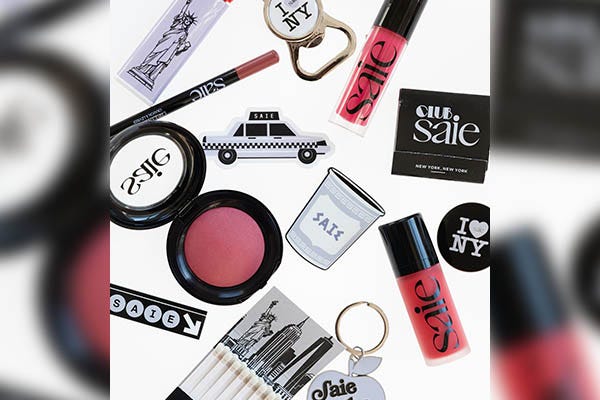
These ingredients don’t just make the makeup glide—they nourish the skin. Their Baked Collection, made through an artisanal process in Italy, infuses moisture into powders so lightweight they feel like suede.
Laney summed it up beautifully:
“I don’t want makeup that settles into fine lines. I want skin to look like skin.”
This is beauty that supports aging skin, not battles it.
Beauty as Activism—And as a Parenting Philosophy
Laney’s climate motivation is deeply personal. She’s raising two young daughters in a warming world, and she feels the same climate anxiety so many of us do.
But instead of letting the anxiety swallow her, she acts.
Eelgrass restoration in her local waterways.
Plastic collection projects.
Daily decision-making at Saie.
Conversations at home about taking responsibility.
“Action is how I calm my anxiety,” she said.
It’s a powerful reminder for all of us: the antidote to climate despair is movement.
The Myth She Wants the Industry to Drop
Laney doesn’t hesitate here:
The idea that sustainability and profitability can’t coexist.
Saie is growing quickly, and they’re doing it while building biodiverse governance structures, transparent supply chains, and climate-aligned packaging standards.
Regeneration and revenue are not opposites. They’re interdependent.
Imagining a Planet Beautiful
When I asked Laney what “Planet Beautiful” means to her, she reached back to childhood memories of snorkeling in oceans full of life—coral, color, abundance.
Those ecosystems look very different today. But pockets of hope exist.
Kelp forests rebound.
Whales return.
Marine sanctuaries heal.
Communities mobilize.
She holds onto that hope. I do too.
The Invitation
Brands can do better—and some already are. Saie is one of them.
Our choices matter:
Buying from climate-conscious companies
Returning empties to Pact bins
Reducing single-use plastics
Learning more, caring more, and engaging more
As I often say on Care More Be Better:
Every day, every choice is a chance to contribute to a healthier planet.
If you want to learn more about Saie’s sustainability work or watch The Saie Way, visit SaieHello.com.
If you want to support Prescott College, our cause partner championing environmental education and social equity, you can do that at CareMoreBeBetter.com.
Together, we can create a more regenerative and beautiful future for all.